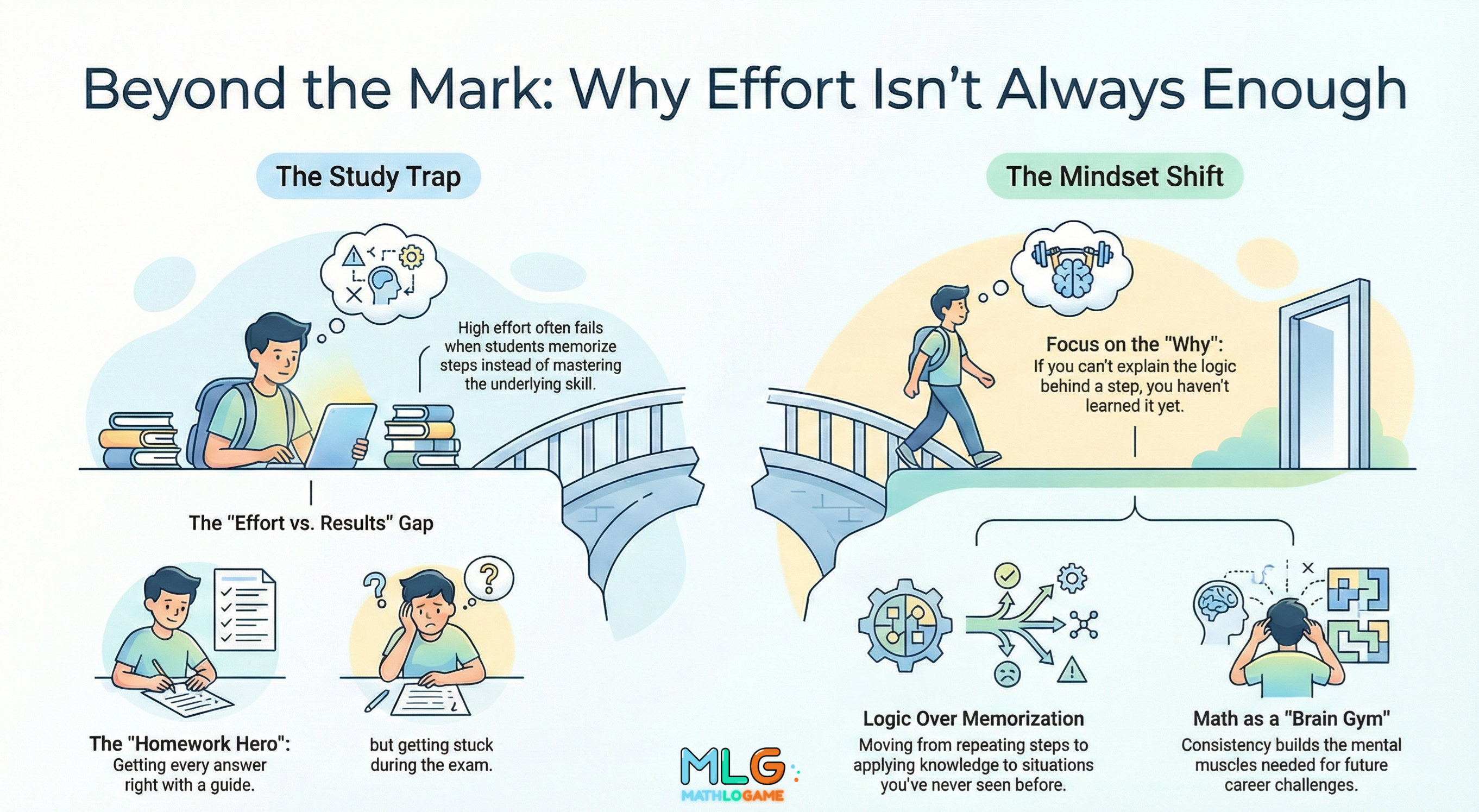
Last week a student stayed after class to tell me something. She said, "Teacher, I understood everything during the lesson. I really did. But then the quiz came the next morning and I just — went blank." She wasn't making excuses. She was genuinely confused, and a little shaken.
I've heard some version of that sentence dozens of times over the years. And every time, my answer is the same: what happened to you is not a memory problem. It's a definition-of-learning problem. You didn't actually learn it yet. You were exposed to it — which is not the same thing.
Recognizing versus producing
Here is a distinction I wish someone had handed me when I was a student. There are two very different things that feel like understanding:
The first is recognizing. You read a solved example. The steps make sense. You nod. "Yes, I see why they did that." That feeling is real — but it belongs to someone else's thinking. You followed along. You did not drive.
The second is producing. You close the book, take a blank page, and reconstruct the solution yourself — from nothing. No hints, no guide, no safety net. If you can do that, the skill is actually yours.
Reading the textbook example and nodding is exposure. It is comfortable and it feels productive. It is not learning. Real learning is what survives the night — what you can still do tomorrow morning on a blank page.
The day-after test
I've started asking my students to build one tiny habit into every study session. I call it the day-after test, and it takes about ten minutes.
- At the end of your session, mark one or two problems — ones you just worked through and felt you understood.
- The next day, before you open anything — no notes, no textbook, no phone — take a blank page and redo them from scratch.
- Read the result honestly. If you can do it, the skill is yours. If you can't, you've found exactly the spot that needs more work. That gap is not failure — it's information.
That's it. No elaborate system. No colour-coded notebook. Just the honest question: can I still do this tomorrow?
What it looks like in practice
Say you spend Tuesday evening learning how to solve $3(x - 4) = 9$. You follow the steps, you get $x = 7$, everything clicks.
Day 1 — during the session: you watch the example, you work through it alongside your notes, it makes complete sense. You feel good.
Day 2 — blank page, no notes: you write the equation at the top of the page and try to begin. Can you? Do you remember to distribute the 3 first? Do you know which operation to undo, and in what order? Can you explain why you're doing each step, not just that you're doing it?
If you can work through it cleanly on Wednesday morning, you own that skill. If you stall at the first step, you now know exactly what to revisit — and you know it on Wednesday, not at 8 pm before Thursday's exam.
What you can solve tomorrow, with no notes, on a blank page — that's what you actually learned today. Everything else was just exposure.
The objection I always hear
"I don't have time to redo problems. I have new material to cover."
I understand that. But consider what you're building if you skip this step. You move forward on skills that haven't actually set yet. The new material piles on top of a shaky foundation. By exam week, you have ten topics you were "exposed to" and very few you actually own.
Ten minutes redoing two problems the morning after — problems you already worked through — costs almost nothing. It tells you immediately whether the work from yesterday stuck. If it did, you move on with confidence. If it didn't, you spend fifteen minutes fixing the exact gap rather than an hour re-reading a whole chapter trying to find where things went wrong.
You're not doing extra work. You're doing better work.
If you're going to take one thing from this piece, let it be this: after your next study session, circle one problem. Tomorrow morning, redo it. Don't check your notes first. Just try. The result will tell you more about your learning than an hour of re-reading ever could.
A short note to fellow teachers
If you want to wire this habit into your classroom without adding a new assignment, try this: ask students to circle one problem from yesterday's homework. At the start of today's class — before anything else — they take a blank sheet and redo it. No notes, no neighbour, no phone. Then they check their own work against yesterday's. That self-comparison is the whole lesson. Students who can reproduce it are ready to move forward. Students who can't have identified exactly where to go back — and they found it themselves, which matters more than you telling them.
~ Salah Alkmali