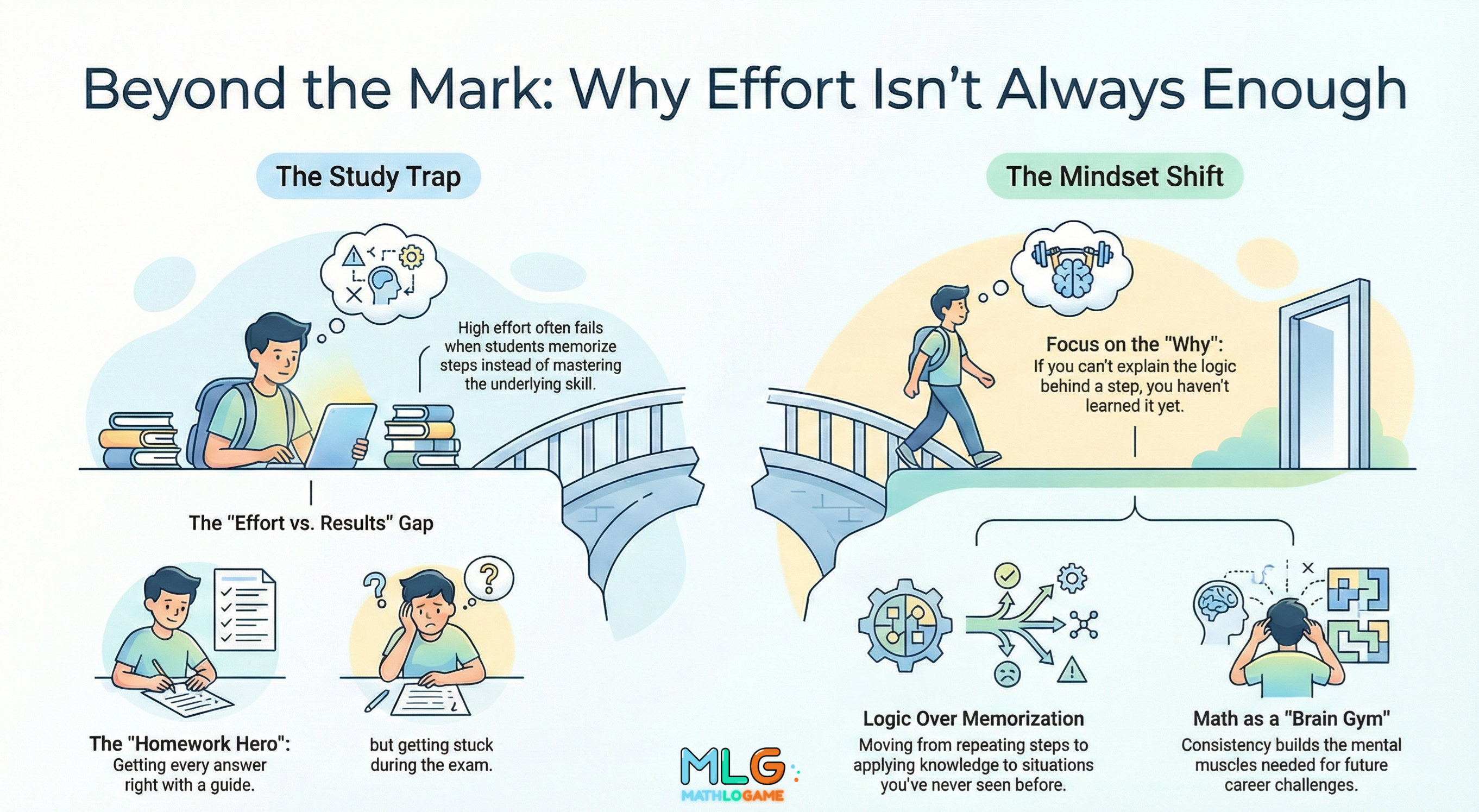
It honestly makes me sad when a student comes to me and says, "Teacher, I really did my best. I studied for hours. So why did I get a low mark?". I see this happen a lot, and if this sounds like you, I want you to know: it's not because you aren't "smart enough".
The problem is usually that you are working hard, but you might be focusing on the wrong things during your study time. To fix this, we need to look at how you actually handle your daily work.
Which of these sounds like you?
In my classroom, I've noticed that most students fall into one of these five patterns:
- The "Steady Achiever": You have a strong background and you actually enjoy the "puzzle" of math. You do your homework consistently, you understand the logic behind the steps, and because of that, you pass exams without feeling overwhelmed. You are already building the "mental muscles" needed for the next level.
- The "Homework Hero": You spend hours on homework and get every answer right because you follow the steps from a similar problem. But in the exam, when you don't have that "privilege" of a guide, you get stuck because you practiced following steps rather than catching the actual skill.
- The "Confused Smart Student": You are smart and you work hard, but during the exam, everything gets mixed up. You haven't yet learned how to identify which specific skill to use for which specific case.
- The "Exam-Only" Student: You think you're smart enough to only study when there's a test. You might get a good mark now, but you aren't building the long-term strength you'll need later.
- The "Giving Up" Student: You've convinced yourself you just "can't do math," so you don't even try.
Why Memorizing is Actually the "Hard Way"
I know most of you want the fastest way to a high grade, but here is the secret:
Memorizing steps is a trap.
In school, you can sometimes get by repeating steps, but real-world challenges—and the college environment you are heading toward—don't come with "similar questions" to copy. If you only study to pass the next test, you aren't preparing your brain for situations where there is no clear answer.
The real trick to mastering math is learning the logic. When you understand the "why," you don't have to memorize a hundred different problems; you only have to learn one system that works for all of them. This is why "Steady Achievers" find exams easier—they aren't remembering answers; they are applying a process.
Let me show you what I mean
Take a simple equation: 2x + 5 = 11.
Here's how a "Homework Hero" thinks about it:
"OK, the example in the book did 'minus 5, then divide by 2.' So I'll do that. Answer: x = 3."
They got it right. Great. But now the exam asks: 3(x − 4) = 9. Suddenly the "minus 5, divide by 2" recipe doesn't fit. They freeze. They guess. They lose marks.
Here's how a "Steady Achiever" thinks about the same first problem:
"x is buried under stuff. I need to peel the stuff off, one layer at a time, doing the same thing to both sides so the equation stays balanced. The +5 goes first because it's the outer layer. Then the ×2."
That second student isn't smarter. They just learned the idea behind the steps — "isolate x by undoing operations, in reverse order, on both sides." That one idea works for every linear equation they'll ever see, including the trick ones the textbook didn't cover.
This is the difference. Memorizing recipes makes you faster on familiar problems and helpless on new ones. Understanding the idea makes you slower at first — and unstoppable later.
How to Upgrade Your Strategy Today
If you want your marks to reflect your effort, you need to change how you practice:
- Don't just follow—understand: Instead of copying steps, ask yourself "Why am I doing this step?". If you can't explain the "why," you haven't learned the skill yet.
- Make the process visible: Use tools that show you the transformation of a problem, not just the final answer. Focus on the process, because that is where the real thinking happens.
- Treat math like a brain gym: You don't go to the gym once a month and expect to be strong. You have to show up and give effort consistently, even when it's boring. Every tough problem you struggle with is making your brain more flexible for the next challenge.
- Use tools as a guide, not to do the work: If you use AI or digital tools, don't let them do the thinking for you. Use them to get a "roadmap" or a step-by-step explanation so you can eventually do it on your own.
A 3-Step Routine for Studying a New Topic
If you don't know where to start, try this. It's the same loop I use with my own students, and it works for any new skill — not just math.
- Watch one solved example carefully. Read the textbook example or watch one short video. Don't move on yet. For each step, force yourself to answer "why is this step legal?" If you can't explain it in your own words, re-read it. The goal here isn't speed — it's understanding what the rules actually are.
- Solve a copy with the example covered. Take a similar problem. Cover the solved example with your hand or a piece of paper. Try it on your own. When you get stuck, peek — but only at the next step you needed, then cover it again. This is where the actual learning happens. The struggle is not failure; it's the workout.
- Solve a different problem, fully alone. Pick a problem from the homework or the back of the chapter that doesn't match the example exactly. If you can solve it, the skill is yours. If you can't, go back to step 1 — there's still a piece you didn't get. That's not weakness; that's information.
Three problems done this way will teach you more than thirty done on autopilot. I've watched it happen too many times to doubt it.
Final Thoughts: You Are Still Learning 🌟
If you are getting low marks despite your effort, it doesn't mean you've failed; it just means your study method hasn't caught up to your potential yet. You aren't "bad at math"—you are just learning how to train your brain.
When you focus on how to think clearly and break big problems into smaller parts, the marks will follow naturally—not just in math, but in life.
Let's keep building, one step at a time.
A short note to fellow teachers
If you've been teaching long enough, you've met all five of those students. The painful one is usually the "Homework Hero" — the kid whose notebook is immaculate and whose exam mark is mysteriously low. We tend to read that as "didn't try hard enough." It's almost never that.
What worked for me: stop grading the homework on whether the answer is right. Grade a few of them on whether the student can explain a step they did. One sentence per problem: "I subtracted 5 because…" That tiny change kills the recipe-following habit faster than any lecture about study skills. They start writing for understanding, because that's what's being measured.
~ Salah Alkmali